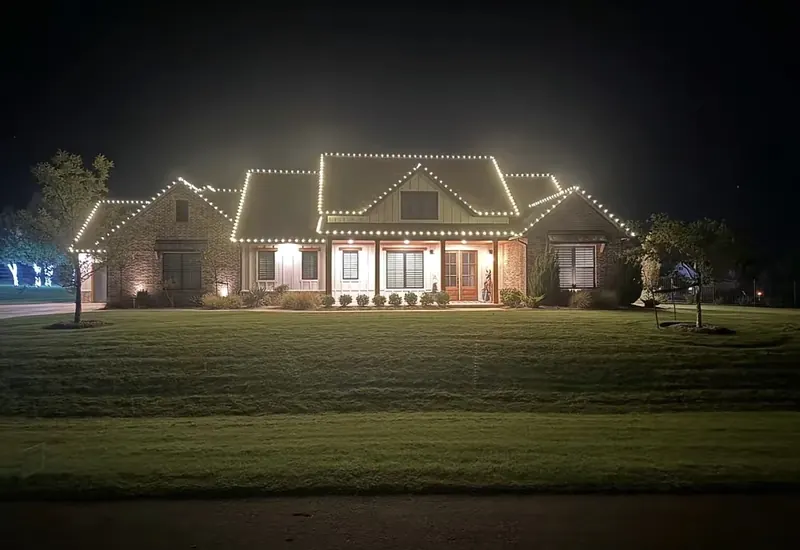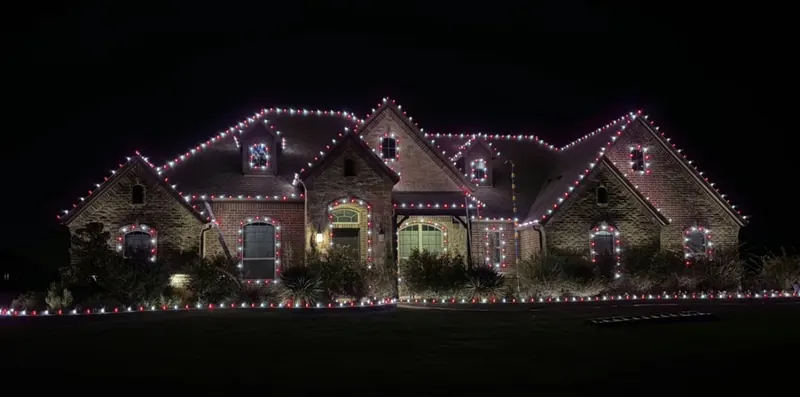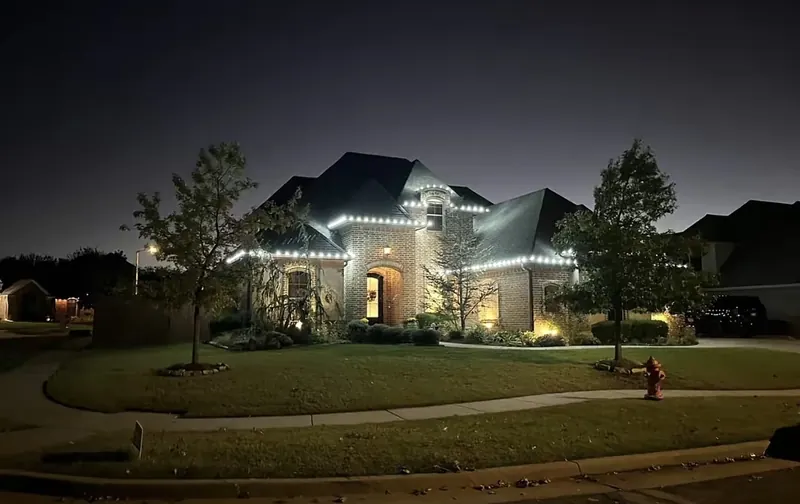
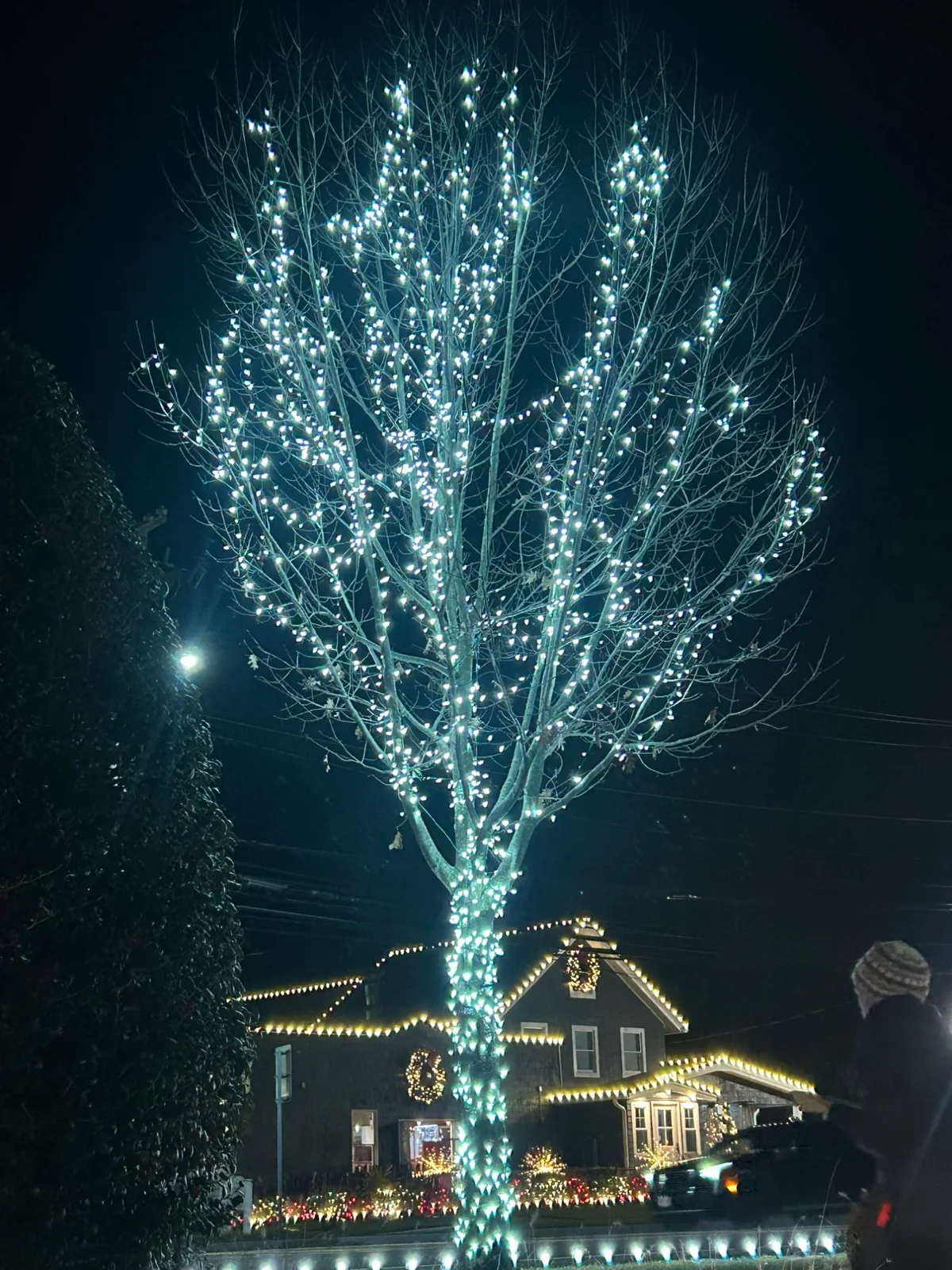
Two kinds of lights show up on most of the houses we do. C9 bulbs and mini lights. They are not interchangeable. Put the wrong one in the wrong spot and the house looks off from the street, even if nobody can say why. Here is how we use each one and why.
C9 bulbs belong on the roofline
C9 is the big bulb. It is the one you picture on a colonial in Sayville or a hi-ranch in Ronkonkoma. We use LED C9 bulbs on rooflines, and only C9. Each bulb reads as its own point of light. From the sidewalk, from a car, from the end of the block, you see a clean line of dots tracing the edge of the roof. That is the whole job of a roofline. It outlines the shape of the house.
Mini lights on a roofline do the opposite. The bulbs sit so close together that the line blurs into a glow. Up close it looks busy. From the street the peaks flatten out and the gutter reads as one long stripe.
Warm white C9 is the classic. Pure white reads sharp against brick. Cedar shake and dark siding pick up warm white well. Red and white, or a solid color like green, blue or team colors, work on C9 too. The bulb size is what makes the line legible. The color is the choice on top of that.
Mini lights belong on trees, columns and railings
Mini lights are for wrapping. Trees, shrubs, railings, porch columns. Here the goal is not a line. It is a solid shape of light. A wrapped trunk in Massapequa, a lit column in Garden City, a row of shrubs along a walk in Bay Shore. Mini lights sit close together, so a wrapped trunk fills in and glows as one piece. C9 bulbs on a tree trunk look like a string of marbles. Too few points, too far apart.
So the split is simple:
- Roofline: C9 LED bulbs.
- Trees, shrubs, railings, columns: mini lights.
- Front door and windows: lit wreaths and garland.
- Beds and paths: landscape and walkway lighting.
Put all of it together and that is what we call the works. Roof, wreaths, columns, uplit beds, walkway.
Spacing is the thing you notice without noticing
A C9 line looks right when the bulbs are evenly spaced all the way around the house. It looks wrong when the spacing shifts at a corner, or a strand runs out short of the peak and the last bulb sits in the middle of nowhere, or a bunch of extra bulbs gets stuffed behind a gutter.
That is why we measure and cut strands to the roofline. Every run is cut to fit that section of that house, so bulb spacing stays even across the whole front. The corners land clean. The peaks end where they should. There is no slack coiled up at the end.
A strand that was not cut for your roof has to end somewhere. Usually that is short of the corner, or past it. Either way the spacing is the first thing to go.
Clipped, never stapled
Every strand we hang is clipped to the shingle or the gutter. No staples. No nails. No holes in your shingles.
Long Island gets nor'easters and wind. A draped or stapled line moves in the first real blow, and then the spacing you paid attention to is gone. Clipped lines and cut-to-fit strands hold better in that weather. If a strand does come down in a storm, or a bulb goes out, we come out and fix it during the season at no charge. Ice and wind can push an install date for safety; we would rather move a day than put someone on an icy roof.
What reads from the street
Stand at the curb and look. That is the test. From there you want:
- A clean C9 line that shows the shape of the roof, peaks included.
- Wrapped trunks and columns that glow as solid shapes, not scattered dots.
- Even spacing. No gaps at corners, no bunching.
- Everything on a timer, so it comes on at dusk every night without you touching it.
No ladder for you. We supply the lights, we hang them, we take them down in January, label them by section and store them. Year two is a same-day install because the strands are already cut for your roof.
We do Suffolk and Nassau, from Bohemia and Patchogue out to Smithtown and Port Jefferson, and across to Merrick, Bellmore and Syosset. Quotes happen in September and October. Installs run in November. Most years the calendar fills before December.
If you want a flat price in writing for your roofline, call 516-434-1726 or use the quote form on the site. We come out, measure, and put a number on paper. No deposit just to get a number.